 |
|||||||||||||||||||||||||||||||||||||||||||||||||||||||||||||||||||||||||||||||||||||||||||||||||||||||||||||
|
|||||||||||||||||||||||||||||||||||||||||||||||||||||||||||||||||||||||||||||||||||||||||||||||||||||||||||||
Previous Events
| |||||||||||||||||||||||||||||||||||||||||||||||||||||||||||||||||||||||||||||||||||||||||||||||||||||||||||||






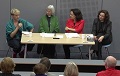


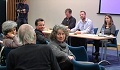
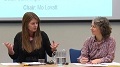


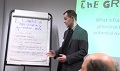
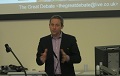
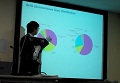


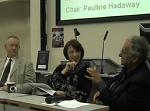







 Photographs courtesy of Henry Rong




|
2017
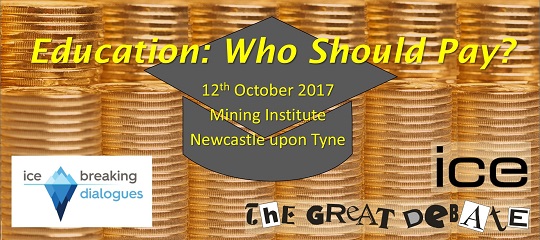
The Great Debate
ice north east and The Great Debate present
Education: Who Should Pay?
What is the right balance between publicly and privately funded university education? Some argue that society benefits from an educated population, especially in STEM subjects (Science, Technology, Engineering, Mathematics), and that the cost of education should thus be borne by the tax-payer. Others argue that it is individuals who benefit most and that students should be expected to pay for their education. In 30 years the UK has shifted from a system in which students received maintenance grants and paid no fees to one in which students are expected to take out loans to cover maintenance and tuition fees. Which is better? How should university education be paid for? Should individuals pay for their own education? Or should the state pay? Does the current policy fail poorer students, restricting access to Higher Education? Is there a better way to pay?
Nicky Turnbull, Newcastle College; Mo Parkin, Ryder Architecture and PlanBEE; Bradley Reid, Northumbria University. Chair: Caspar Hewett, Director, The Great Debate
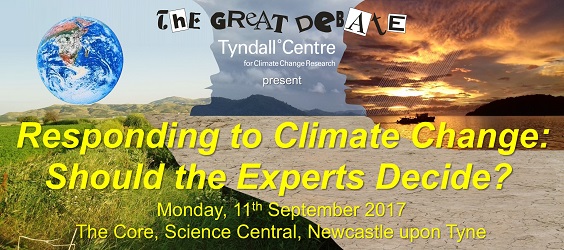
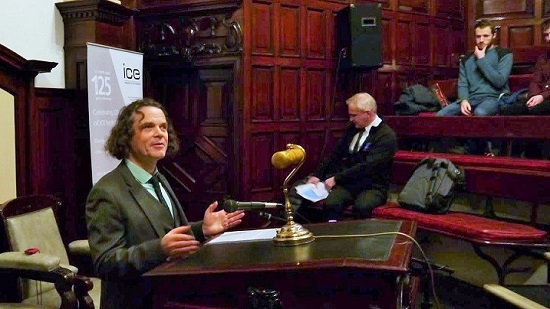
Tyndall Centre for Climate Change Research and
The Great Debate present
Public distrust of experts has become a hot topic recently, notably in the discussions surrounding Brexit and the US presidential election. This gives rise to serious questions about what part expertise should play in decision making and whether this is compatible with democracy. What does this mean for climate change policy? Some argue that, given the scientific consensus on climate change, policy should be driven by the experts. Others argue that the science of climate change is only a small part of the story when it comes to making decisions about, for example, energy policy. So, how much weight should be given to the views of climate scientists? How do we make the right decisions about our future? More ...
Speakers Chair: Caspar Hewett, Director, The Great Debate
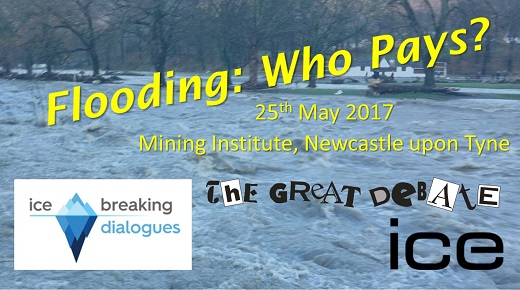
ice north east and The Great Debate present
ice breaking dialogue 2: Discussion about the threats, solutions and impacts of flooding to North East homes, businesses, people and infrastructure. Do we have to accept and live with the threat of flooding? Should we build in areas prone to flooding? How can we be protected and who is responsible for that protection? Who pays?
Prof. Louise Bracken, Durham University David Hirst, Ainsty Risk Consulting Ltd Richard Warneford, Northumbrian Water Chair: Caspar Hewett, Director, The Great Debate
ice breaking dialogue 1: The relocation of power away from the centre has major implications for society. Will the government's devolution agenda benefit the North East? Will it enable us to secure much needed investment in our infrastructure? Should we embrace or resist it? We invite anyone interested to discuss the policy changes needed to ensure that devolution works for people, the economy and the environment of the North East.
Speakers: Chair: Caspar Hewett, Director, The Great Debate
1998 1999
2000 2001
2002 2003
2004 2005
2006 2007
2008 2009 |
|
2016
Humanity’s Big Challenge: Water Wars Water, so vital for human life, covers 71% of the Earth’s surface. Yet despite huge progress in technology and modern development, water scarcity is one of the great challenges facing humanity today. Indeed, water scarcity has become an increasingly important debate - globally - in recent years, with water crises in Flint, Michigan and in California becoming just two of the most striking examples of how developed Western nations can struggle to maintain plentiful water supply. While California’s drought-hit residents are blamed for their water-guzzling swimming pools and golf courses, water poverty has begun to be a real concern. In Ireland, disputes about privatisation of the state water company and the introduction of charges led to mass refusal to pay water bills, civil disobedience and even riots, which at times threatened to topple the government. Meanwhile, whilst floods across northern England often dominate headlines, there is growing anxiety over the future of water supply in the UK, particularly in the south-east of England. Despite the increasing intensity of heavy rainfall over recent years, the Environment Agency has classed the south-east region as under ‘serious water stress’, which is compounded by population increases and changes to weather patterns. Why is such a fundamental utility so problematic? Some commentators suggest, in the developed world, these problems are fundamentally infrastructural, driven by inefficiencies in water management and political complacency, and argue that innovative solutions are preferable to rationing measures. Following a prolonged period of low rainfall in the UK up to 2012, water companies were preparing themselves for water-saving and management measures beyond ‘hosepipe bans’ and there are concerns that the recent wet period has only delayed confronting underlying problems rather than being seen purely as a result of weather patterns. In contrast, a dry country like Israel, for example, has overcome a profound crisis through substantial investment in desalination plants and conservation systems. And what of solutions? In England and Wales, up to 20 per cent of water is still lost in the damaged and decrepit underground water supply pipes; environmentalists argue for Sustainable Urban Drainage – absorbing water in green roofs, filling water butts for re-use, and attenuation systems to alleviate urban surface water flooding. This year, even China’s president, Xi Jinping, advocated that China’s cities should be water-absorbent Sponge Cities. But sometimes obvious engineering solutions face political opposition: for example, it is argued by some that the construction of an Abingdon Reservoir would solve most of London’s water problems, but this has been held up by for a decade by opposition from local people. Or perhaps we need to pay more? Once a radical proposal, earlier this year, analysts from Deloitte argued that increasing the price of water – also done in Israel – would incentivise much-needed investment in water systems and alleviate the resulting costs on energy and food production of water scarcity. How has water provision become a problem for even advanced globalised societies? Has a lack of investment and political will created a false problem, or will counter-crisis measures such as rationing become the norm? What happened to sea-water desalination plants? Does a focus on drought and rainfall distract us from a discussion about water as largely a man-made resource like any other, with associated costs? What innovations would help avert a coming crisis and who should pay for them?
Speakers: The Great Debate
Plan it Earth: Is there enough resource for all?
If the geosciences community understands the intimate interactions between for example water, energy and food supply, a view expressed recently in terms of the water, food and energy nexus, we should be able to make a real contribution to joined-up thinking in the way that resources are managed. So, how can we ensure that our understanding influences management practices? Can we identify underlying approaches to apply to problems? Can we solve current problems without compromising the requirements of the future? Speakers: Günter Blöschl, Livia Peiser, Ioana Popescu and James Woudhuysen
Full details
1998 1999
2000 2001
2002 2003
2004 2005
2006 2007
2008 2009 |
|
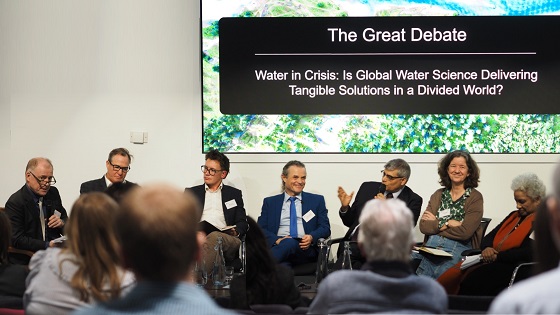
The thirsty 10 billion: Are we managing? Convened by: Jonathan Dick, Caspar Hewett, Paul Quinn, Mark Wilkinson, Oksana Tarasova, Efi Foufoula, Hubert H.G. Savenije Water security is one of the great challenges facing humanity today with more than one third of the world’s population living in water-stressed areas. Difficult questions need to be addressed about how we manage and consume water - for domestic, industrial and agricultural purposes. With the United Nations predicting a world population in excess of 10 billion by 2100 and climate change potentially further threatening people's access to potable water, are we doing what is necessary to secure our water resources? There is immense expertise and knowledge in the science and engineering communities on how to make best use of the resources we have, from better storage and infrastructure to drip irrigation, wastewater processing and efficient desalination. So, what can we do to make sure that people have the water they need? What legacy do we want future generations to inherit in terms of water security? What are we doing right and what can we do better to manage this most essential of all resources?
Chair: Dr Caspar Hewett
Click here for
full details
1998 1999
2000 2001
2002 2003
2004 2005
2006 2007
2008 2009 |
|
2014
The Great Debate
Speakers: Come and share your views and experiences on whether or not “community” is an out-dated term for LGBT people in North East England. This is the first of a series of debates we are presenting as part of the Sal Lumsden Archive Project in association with The Great Debate. Contact: office@communityhubsnetwork.org
Debating the State of the Nation What is the current state of the North East's infrastructure? How does it compare with the rest of the country? What should we prioritize over the next decade and the next half century? A panel of engineers introduced the current state of play based on the latest ICE State of the Nation Report, followed by an hour of discussion with the audience. More ...
Introduced by Nick Baveystock, Director General,
Institution of Civil Engineers
The Fracking Great Debate Should we exploit the UK's onshore shale gas, and if so under what conditions? Induced hydraulic fracturing (widely referred to as fracking) has been in use since the 1940s but has recently come to the fore as a means of releasing natural gas stored in shale rocks that would otherwise be inaccessible. This technology has huge potential for providing gas for energy generation, and has become increasingly attractive as gas prices have risen and the natural gas that can be easily extracted has been depleted. However, there is significant resistance to the technology due to potential environmental risks of its widespread use, such as ground water contamination and the migration of gases and chemicals to the surface. This event explored the question 'Should we exploit the UK's onshore shale gas, and if so under what conditions?' using the new economics foundation's Crowd Wise process: Beginning with the central question "Should we exploit the UK's onshore shale gas, and if so under what conditions?" participants (panel and audience) will be invited to work together to create and refine possible answers with a view to deciding jointly what the best solutions are. More ...
Speakers:
Geoengineering the climate:
the way forward?
Convener: Caspar Hewett For years geoengineering, defined by the United Kingdom’s Royal Society as “the deliberate large-scale manipulation of the planetary environment to counteract anthropogenic climate change,” was seen by many as a peripheral and slightly bizarre area of research. However, given ongoing difficulties with negotiating emission reduction targets and with 2015 fast approaching – the year when countries have to conclude a global climate agreement through the United Nations Framework Convention on Climate Change – many have started taking geoengineering seriously as a potential way to offset the negative consequences of climate change. When the recent IPCC report suggested that geoengineering the climate could be necessary to meet climate goals, it brought the controversy over the topic into the spotlight. So, how feasible is it to manipulate the Earth system for our own ends? Is it something we should be doing? Or will it do more harm than good? Proponents of geoengineering argue that it is an essential component to counteract climate change and that it provides a cost-effective alternative to reducing carbon emissions. Those against it argue the risks are too great and the unknowns too numerous. So what stand should geoscientists take on this? Should there be a major push for research funding for this area? Should we be going ahead with large-scale experiments? More ...
Panellists:
The Great Debate in association with
Institute of Hazard,
Risk and Reslience,
The event used the new economics foundation's Crowd Wise process to explore the topic.
Speakers: Facilitators: Perry Walker and Caspar Hewett
The Wonders of Engineering held as part of the ETUDE project From the micro to mega, engineering influences every aspect of our lives today. This one-day extravaganza was an opportunity to hear about the cutting edge from fifteen engineers from around the country. Talks, discussions and exhibits all mixed with a dash of comedy took the audience through a wonder tour of engineering today, and offered the opportunity to ask questions, challenge assumptions and engage in debate. More ... Contributors: Eric Asare, Aidan Burton, Xiaohong Chen, Eiman ElBanhawy, Michael Hanif, Caspar Hewett, Fadi Kahwash, Emma Kennard, Bassem Mady, Siti Misti, Mahmood Mohamed, Bobo Ng, Gobind Pillai, Jeffri Ramli, Radu Sporea and Xiangdong Xue
1998 1999
2000 2001
2002 2003
2004 2005
2006 2007
2008 2009 |


Newcastle Institute for Social Renewal,
NECTER / RCE North East and The Great Debate present
Media, Culture, Voice: Tackling inequality and marginalisation 7pm, Monday, 15th July 2013, Northumbria University
What roles can and should media and culture play
in tackling inequality and enabling the marginalised to 'speak'?
Is there are a risk of 'culture' becoming social policy for the poor and
leisure for the rich?
Running from March to October 2013 The Great Debate, in partnership with NECTER and Great North Festival, ran a free programme of documentary-making workshops for young people not in employment, education or training. The project provided opportunities for partiicpants to learn about every aspect of film-making,from camera work, sound and editing to interviewing and presenting. Funding for the project was was obtained by NECTER from The Big Lottery Fund's Awards for All programme and linked in with The Great Debate's great northern youth voices project, which resumes in January 2014. Click Here for HYPODcasts - videos produced by project participants.
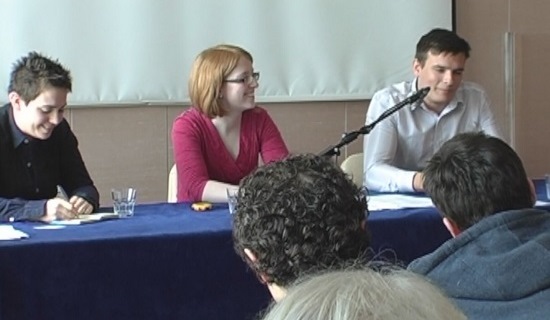
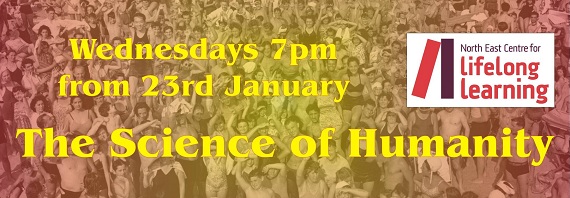
The Science of Humanity
1 The view of humanity up to and including the scientific revolution
1998 1999
2000 2001
2002 2003
2004 2005
2006 2007
2008 2009 |









|
2012
Saturday, 10th November 2012 Newcastle University Funded by Economic and Social Research Council and Newcastle Institute for Social Renewal A day of active debate and documentary-making held as part of ESRC Festival of Social Science. The event took a critical look at how the ideal of equality has been eroded in recent times, becoming replaced by notions of equity and the celebration of difference. More ...
The Great Infrastructure Debate Part of the Sustained Engagement project funded by Royal Academy of Engineering.
Wednesday, 14th March 2012 Newcastle Business School & School of Law Building Northumbria University Part of the Sustained Engagement project funded by Royal Academy of Engineering.
1998 1999
2000 2001
2002 2003
2004 2005
2006 2007
2008 2009 |

|
2011
The Future of Energy for the North East
Part of the Sustained Engagement project funded by Royal Academy of Engineering. How will the North East of England meet its energy needs in 30 years time?
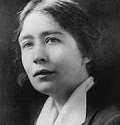
Sylvia Pankhurst: Everything is Possible
Tickets £5 / £3.50 concessions / £2 for school students
Newcastle University Year of Sustainability school debate competition
Saturday 5th November 2011 Devonshire Building (map), Newcastle University FREE day of argument and documentary-making. The day includes active debates open to all on population and the limits to social and technical engineering and a film-training workshop for young people. Speakers include Ian Abley, architect and director of audacity; Barry K Gills, Professor of Global Politics, Newcastle University; Patrick Hayes, political commentator, Spiked Online; Sandy Irvine, Chair, Newcastle Green Party; Roger Martin, Chair, Population Matters; and Ludi Simpson, Professor of Population Studies, Cathie Marsh Centre for Census and Survey Research (CCSR). More ...
Visions for the Future of the City
What should Newcastle upon Tyne look like in 2050?
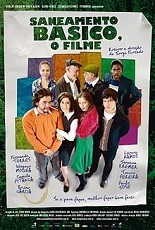
7.30pm, Wednesday, 6th July Celebrated Brazilian director Jorge Furtado turns his innovative filmmaking approach to the story of a town who need to build a new sewer. Whilst there is no state money for a new drain there is funding available to make an educational film. A young couple do some creative budgeting, planning to have enough money to make a low-budget film and a new sewer. Superbly acted, this is an upbeat and comic look at social activism and how government funding, or lack of it, can shape communities. Starring Fernanda Torres, Wagner Moura, Camila Pitanga, Bruno Garcia, Lázaro Ramos, Tonico Pereira and Paulo José.
Brazil 2007 Dir. Jorge Furtado Showing as part of RCE North East 2011 programme of events in partnership with Newcastle University and Newcastle Institute for Research on Sustainability.
1998 1999
2000 2001
2002 2003
2004 2005
2006 2007
2008 2009 |


|
2010
The Great Debate Head to Head
Is economic growth a good thing? Until the 1970s few would
have even thought of asking this question.
Yet today the West is often seen as guilty of overconsumption,
while the rapid growth of developing countries such as China
and India is seen by many in a highly negative light.
People who champion growth are accused
of encouraging greed, damaging the environment and
widening social inequalities. Daniel Ben-Ami, in his new book
Ferraris for all,
challenges these notions, arguing that
society as a whole benefits from greater affluence and that we
should celebrate growth. Renowned environmentalist and writer
Jonathon Porritt
disagrees and took up the arguments ...
View Video
The Great Debate Green Phoenix festival programme
What is Sustainable Culture?; Are we masters of our own destiny?; The Borders of Reality; Food and Water Security; Limits to Growth in 21st Century; Energising Innovation; Limits to Freedom; The Legacy of Multiculturalism; Limits to Imagination; Full details
Carbon Trading
Global Water Security
2030: Engineering Our Climate
Members book group: Robert Winston
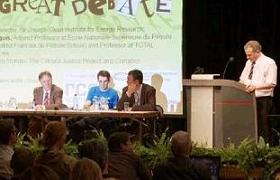
The Great Debate@EGU
Chair: Dr Paul Quinn, Newcastle University Speakers: Dermot Roddy, Science City Professor of Energy, Newcastle upon Tyne, Director, Sir Joseph Swan Institute for Energy Research; Hervé Coutrix, Vice President Geosciences Structural and Sedimentological studies, TOTAL; Niel Bowerman, co-founder and former Executive Director, Climatico, co-founder, The Climate Justice Project
The Great Debate and
North East Centre for Lifelong Learning present
Speakers included Tony Allan, Stockholm Water Prize Laureate 2008, founder of London University's Water Issues Group; Greg Bankoff, environmental historian, University of Hull, Jennie Barron, research fellow in water management at Stockholm Environment Institute; Julia Brown, lecturer in Environmental Policy, Planning and Management, University of Portsmouth; Ben Campbell, social anthropologist, Durham University; Steve Caseley, Director of Distributed Energy, New and Renewable Energy Centre; Tim Foxon, academic research fellow at Sustainability Research Institute, Leeds; Joanna Haigh, professor of atmospheric physics, Imperial College, contributor to the recent Royal Society report, Geoengineering the climate; Phil Macnaghten, founding Director of Institute of Hazard and Risk Research, Durham University; Rob Williams, Renewables Projects Director, Banks Developments.
The Great Debate:
Humans in a Changing Climate
Week 1 (4 Feb): Introduction by Dr Caspar Hewett. How the media treat climate change issues. How can we read between the lines? Week 2 (11 Feb): Dr Stephen Blenkinsop, Newcastle University, tells us about what climate change can and cannot tell us. Week 3 (18 Feb): Dr Richard Dawson, Tyndall Centre for Climate Change Research, talks about the challenges of adapting cities to address a changing climate. Week 4 (25 Feb): Dr Annie Borland, Moorbank Botanical Garden, on what the biological sciences can do for us. Week 5 (4 March): Review with Caspar Hewett
The Climate e-mail Row:
What does it tell us about science?
'It's the end of the world as we know it
(and I feel fine): Why environmentalism has failed
and what comes next.' Paul Kingsnorth, author, One No, Many Yeses, Real England, has been a peace observer in Mexico, a floor-sweeper in McDonalds and a history student at Oxford University. He was arrested during the Twyford Down road protests in the 1990s and was named one of Britain's 'top ten troublemakers' by New Statesman in 2001. He has worked on the comment desk of The Independent, as commissioning editor for opendemocracy.net and as deputy editor of The Ecologist. He is also an award-winning poet, and an honorary member of the Lani tribe of New Guinea.
This event is linked to the Space of Democracy and the Democracy of Space network. For further information e-mail Jonathan Pugh
Children and Cities
At this seminar Ken Worpole was presenting a version of his contribution to the book What is Radical Politics Today? edited by Jonathan Pugh of Newcastle University, and published in November 2009 by Palgrave-Macmillan.
For further information contact Jonathan Pugh
1998 1999
2000 2001
2002 2003
2004 2005
2006 2007
2008 2010 |


|
2009
Water, Water Everywhere?
June 5th
Water, Water Everywhere?
Some argue there is no excuse for water shortages in a water-rich nation like Britain, and that we should build ambitious new infrastructures such as a ‘national grid’ for water. Others think we should be curbing demand to minimise our impact on the environment. Water engineer and chair of The Great Debate, Caspar Hewett and Bruce Horton, environmental adviser for Water UK, join Trevor Bishop from the Environment Agency and Jonathon Porritt to discuss the future of hydrating the nation. Saturday, 14 March 2009 Newcastle University
With: Hilaire Agnama, Teesside One World Centre Paul Chatterton, Leeds University Ceri Dingle - Director of WORLDwrite and Chew on it Productions Caspar Hewett, environmental consultant, Chair of The Great Debate Alex Lockwood, Sunderland University Kate Manzo, Newcastle University Alison Neilson, author Disrupting Privilige, Identity, and Meaning: A Reflective Dance of Environmental Education Viv Regan, Assistant Director, Producer, WORLDwrite Nathalie Rothschild, commissioning editor, spiked-online Click here for full details Part of The Great Debate schools programme
The “Credit Crunch”: Consequences for UK Households
Chaired by Dr Paul Langley, Northumbria University, this event will feature a series of short contributions from recognized experts in the field: Professor Susan Smith, Durham University; Professor Mark Stephens, University of Glasgow; and Dr Lavinia Mitton, University of Kent.
For further details please visit
The
“Credit Crunch” debate.
1998 1999
2000 2001
2002 2003
2004 2005
2006 2007
2009 2010 |



| 2008
The Great Debate: What is radical politics today? 12.30-1.30pm, Friday, 5th December 2008 Fine Art Lecture Theatre, Newcastle University
Speakers:
What is the nature of radical politics today?
Flush it!
The film’s première was followed by a question and answer session with Dr Caspar Hewett, Chair of The Great Debate and Viv Regan, the film’s producer.
Click
here for full details of this session and the Battle of Ideas 2008
Agents of Change? Darwinian Thought and Theories of
Human Nature Revisited
9am – 4pm, Saturday, 25th October 2008
Darwinism or Darwinitis?
The Great Human Nature Debate
What can science tell us about human nature?
Speakers: Igor Aleksander, author The World in My Mind, How to Build a Mind Bruce Charlton, author Psychiatry and the Human Condition Kenan Malik, author Man, Beast and Zombie Chair: Pauline Hadaway, Director, Belfast Exposed Come along, hear the arguments and have your say Click here for full details
Information-processing in Robotics, Biology and Philosophy:
Unnoticed Connections What can biologists, roboticists and philosophers learn from one another?
Come along, hear the arguments and have your say
Speaker:
Aaron Sloman,
University of Birmingham
Selfish Genes, Sex, and Sanity
What are the connections between mental illness and genetics?
Related links:
The Great Sustainable Energy Debate 2008
Lecture Theatre CCE1-401 (TLT)
Featuring:
The Great Sustainable Energy Debate 2008 proceedings by Caspar Hewett
Progress of the Human Mind: From Enlightenment to Postmodernism
Notes
Developing World Challenges
Speakers Ceri Dingle, Director of WORLDwrite and Chew on it Productions Viv Regan, Producer, WORLDwrite and Chew on it Productions Kim Tan, Campaigns Officer for Oxfam UK Barry K.Gills, Professor of Global Politics, Newcastle University John Gowing, Reader in Agricultural Water Management, Newcastle University Bill Colwell, Atlantic Pictures Hilaire Agnama, Development Education Worker Click Here for full details
Authority, Respect and Human Potential in the 21st Century The Great Debate opened its 10th Anniversary celebration with a discussion exploring the themes of authority and human potential, examining how they are linked to the erosion of respect in modern society. What is meant by authority, respect and human potential today? Since the Enlightenment the idea of the subject has had a central place in the way that we think about ourselves. This understanding of what it is to be human rests on the idea that we are active agents who do things for reasons and shape the world to our own ends. Yet in recent years this view of human nature has become deeply unpopular and we are encouraged to think of ourselves as objects at the mercy of outside forces. At the same time something else seems to be contributing to this historical moment; something that has been left unexplored by many thinkers. This is the erosion of respect for authority, reflected in modern cynicism about politics and a deep distrust of experts. How closely connected are these changes and how are we to understand them? Introduced by Dr Caspar Hewett
The Great Debate continues to support the acclaimed debating competition for sixth form students As part of The Great Debate schools programme we hope to involve more students in the region in public debate through our continued support of the Institute of Ideas' and Pfizer's Debating Matters Competition. Following its highly successful pilot year, the competition launched in the North East in 2005 and has continued to grow, attracting more and more schools in the region. This year's regional heats saw Durham Johnstone Comprehensive School (Durham), Ryton Comprehensive School (Ryton), St. Mary's Sixth Form College (Newcastle) and Whickham School (Whickham) make it through to the North East regional final which took place at Newcastle University on Monday 28 April 2008. Debating Matters demands more than rhetoric or rant from the sixth form students who take part. Young people are encouraged to research issues thoroughly and become more confident and sophisticated in articulating their views by standing up to a probing intellectual examination. This is all part of the competition's philosophy of privileging reasoned participation over rhetorical posturing. Debate topics engage with contentious contemporary issues and uniquely involve a critical examination of debater's arguments by celebrity judges drawn from the fields of academia, the media and business. The Great Debate's Caspar Hewett, Dave O'Toole, Jon Pugh and Mo Lovatt have been judges in the competition. Click here for further details about the competition
1998 1999
2000 2001
2002 2003
2004 2005
2006 2008
2009 2010 |











|
ESRC Festival of Social Science
The Great Land Use Debate The following on line debate may be of interest to vistors to The Great Debate web site: RELU Great Land Use Debate
Everyone seems to want something different, but can rural land fulfil all of these expectations? What is our long term vision for land use in the UK and do we need an extension of the planning system from town into countryside in order to realise it? The UK research councils’ Rural Economy and Land Use Programme invited contributions to a unique on-line debate during National Science and Engineering Week/Festival of Social Science 2008. The Programme’s land use policy analysts will be posed some key questions to draw in opinion from a wide range of contributors, see the RELU website. |
|
2007
The Great Debate: The New Politics of Climate Change
Monday 25th June 2007 Bedson Teaching Centre, Newcastle University Hosted by Dr Jonathan Pugh Chair: Prof Phil Powrie, Dean of Research for the Faculty of Humanities and Social Sciences, Newcastle University Speakers: Prof Steve Rayner, Director of the James Martin Institute (University of Oxford); Director of the ESRC's ~£5m Science in Society Programme; Member of the Royal Commission on Environmental Pollution, the Oxford Commission on Sustainable Consumption and a lead author on the Third Assessment Report of the Intergovernmental Panel on Climate Change Dr Joe Smith, School of Social Sciences (Open University); Director of the ESRC/NERC/BBC/NEF-sponsored Interdependence Day project  Prof Phil Macnaghten, Department of Geography (Durham University);
Director of the Institute of Hazard and Risk Research (IHRR); Honorary
Professor in the Institute for Advanced Studies at Lancaster University;
Fellow of the Royal Society of Arts, and Senior Associate of Demos
Prof Phil Macnaghten, Department of Geography (Durham University);
Director of the Institute of Hazard and Risk Research (IHRR); Honorary
Professor in the Institute for Advanced Studies at Lancaster University;
Fellow of the Royal Society of Arts, and Senior Associate of Demos
Prof Jim Hall, Professor of Earth Systems Engineering, Newcastle University, advisor to the Stern Review on the Economics of Climate Change, contributing author to Assessment Reports of the Intergovernmental Panel on Climate Change.
All Planned Out:
The Worldwide Impact of the British Town and Country Planning System
The 3rd Workshop on Development, Sustainability and Environment Funded by Economic and Social Research Council and Newcastle Science Festival Saturday, 17th March 2007, 9am-4pm Newcastle University 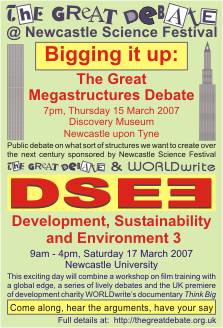 At the opening of the 21st century concern for the environment influences
policy throughout the world.
Any discussion about resources is infused with the
language of sustainability. What does this mean for the developed and
developing worlds? Is our current pattern of water use
sustainable? How are we going to generate sufficient electricity for our future needs?
Is the sort of technology we take for granted in the West appropriate for
the developing world?
At the opening of the 21st century concern for the environment influences
policy throughout the world.
Any discussion about resources is infused with the
language of sustainability. What does this mean for the developed and
developing worlds? Is our current pattern of water use
sustainable? How are we going to generate sufficient electricity for our future needs?
Is the sort of technology we take for granted in the West appropriate for
the developing world?
Combining a workshop on Film training with a global edge, documentary footage from Africa and a series of discussions this one day workshop examined a series of issues related to Development, Sustainability and Environment through debates on three key themes:
Click Here for Proceedings of DSE3
Bigging it up: The Great Megastructures Debate
Proceedings of The Great Megastructures Debate
1998 1999
2000 2001
2002 2003
2004 2005
2007 2008
2009 2010 |



 Chair
Chair |
2005
The Rise and Rise of Evolutionary Psychology
What lies behind the rise and rise of Evolutionary Psychology? What are the implications of this approach? What are its strengths and weaknesses? Why has Evolutionary Psychology proved so popular when sociobiology was rejected so ambivalently?
Chair: Dave O'Toole
Development, Sustainability and Environment
In the last 20 years environmental thinking has become very much a part of
our every day lives. The term 'sustainable development' has entered the
mainstream and is used to guide policy in both the developed and developing
world. Yet whilst we in the West enjoy a safe, clean, pleasant environment
coupled with high living standards the developing world is being discouraged
from aspiring to anything more than basic needs. So what is sustainable
development and what are its consequences? What is current in environmental
thought? Discussion sessions include Energy Futures, Aspirations and keynote debate funded by the RSA; What Future for Environmentalism? Speakers include Sir Bernard Ingham, Keith Barnham, Ian Burdon, Ceri Dingle, Geoff Parkin, Roger Higman, Viv Regan and Tony Gilland
Click Here for further details
The Nature of Being Human
What is that defines a human being? Is it a universal nature? Is it consciousness? Is it our capacity for rational thought? Is it our ecological ability to adapt our environment rather than adapt to it? Can we rely on reason alone? What can we learn about ourselves through the study of evolution? How do these considerations interrelate? Why is it so popular to apply Neo-Darwinist principles to human behaviour and to society? These questions and others were examined through a discussion of what it is to be human with a panel of experts including Colin Talbot, author The Paradoxical Primate, Caspar Hewett, Chair, The Great Debate, Inge Rebergen, Historian and philosopher, Adam Bell, Kantian philosopher
The Great Debate supports North East launch of acclaimed debating competition The Great Debate hopes to involve more students in the region in public debate through its support of the Institute of Ideas' and Pfizer's Debating Matters Competition. Following its highly successful pilot year, the competition launched for the first time in the North East this year. The Great Debate was a partner in the North East region heat that took place at the University of Newcastle on Friday 18 March 2005. Debating Matters demands more than rhetoric or rant from the sixth form students who take part. Young people are encouraged to research issues thoroughly and become more confident and sophisticated in articulating their views by standing up to a probing intellectual examination. This is all part of the competition's philosophy of privileging reasoned participation over rhetorical posturing. Debate topics engage with contentious contemporary issues and uniquely involve a critical examination of debater's arguments by celebrity judges drawn from the fields of academia, the media and business. The debate motions for the North East region heat included: 'Victims should be more involved in the criminal justice system'; 'Conceptual art is not real art'; 'Reducing pollution should be society's top priority'; and 'Human genetic engineering is a step too far'. The Great Debate's Caspar Hewett, Dave O'Toole and Mo Lovatt were judges for the North East region heat. Click here for further details about the competition
The Great Debate: Being Human
Do our genes influence our conscious experiences? Do they explain them? Is the human mind something we can properly study? What can we learn about ourselves through the study of mind from the perspective of evolution? Since Darwin our vision of ourselves as a unique type of being has been progressively undermined. What can recent theories related to evolutionary theory, neurobiology and AI tell us about the experience of being human?
1998 1999
2000 2001
2002 2003
2005 2006
2007 2008
2009 2010 |

|
2004
The Great Debate: Genes, Memes, Minds
in association with the RSA Panel Discussion: 6pm, Tues 30th November 2004
What can evolutionary theory tell us about the human mind?
One of the great triumphs of the late twentieth century was the application
of Darwinian theory to animal behaviour. This led to many attempts to apply
the same methods to human beings and to explain the human mind in evolutionary
terms. Thus we see the rise of the now common phrase ‘the gene for . . .’ in
describing human behaviour. One theory, Evolutionary Psychology, attempts to
explain the mind in terms of evolved predispositions to behave in certain ways.
The theory of the meme rejects the notion that genes are sufficient to explain
cultural evolution - especially in the light of the pace of cultural change. A
meme is a unit of cultural transmission or imitation.
Like the gene, which is a
self-replicating molecule, the meme is a replicator - when a meme is imitated
it has replicated itself. Meme theorists argue that human beings are determined
largely by social factors, not just by genetic code and that there is another
unit of selection at work - the meme. What both these approaches have in common
is the idea that the notion of natural selection, can lead to an understanding
of the human mind.
What are the strengths and weaknesses of these approaches? Why are some
theorists ambivalent about the explanatory value of genes and memes when it
comes to the mind? Is there something fundamental that an evolutionary approach
cannot provide?
The Great Debate: Whatever Happened to the Subject?
Panel Discussion: Thursday 18th March 2004, 7-9pm
Are we masters of our destiny?
Can we really influence the direction of change?
Since the Enlightenment the idea of the subject has had a central place
in thought about the special nature of humanity. This is a description of human
beings as active agents doing things for reasons and shaping the world to their
own ends. Yet, in recent years, fields as diverse as neuroscience, literary
criticism and Evolutionary Psychology have converged on a very different vision
of what we are. In the last twenty years we have been brought a vision of
humans as machines; zombies experiencing the illusion of choice and intentionality.
Why is this? Does this reflect a new understanding of what we really are or are
these interpretations more to do with the way we view ourselves today?
Click Here for proceedings
Playing it Safe: Science and the Risk Society
Panel Discussion: Wednesday 17th March 2004
Is there a case for caution where the outcome of scientific
and technological advances is uncertain?
It is hard to believe that only a short time ago the benefits of scientific progress
were taken for granted. Yet today the tendency is to consider the risks whenever a new
technology is developed. The precautionary principle urges us to err on the side of
caution when knowledge is uncertain and to place a duty
of care on those who propose change. What are the consequences of this new way of
looking at the world? Can we benefit from science without taking risks?
What are the dangers of playing it safe?
Of Blank Slates and Zombies
(Modern Theories of Human Nature)
Day school: Saturday 13th March 2004
Is there a universal human nature? If so, what defines it? Is it consciousness?
Is it our capacity for rational thought? Is it our ability to adapt our environment
rather than adapt to it? This one day course examined some modern ideas of what
human nature is and attempted to draw some conclusions about these questions.
1998 1999
2000 2001
2002 2004
2005 2006
2007 2008
2009 2010 |
|
2003
The Great Debate: Development, Sustainability and Environmentalism
Click Here for proceedings
In the last 20 years environmental thinking has become very
much a part of our every day lives. The term 'sustainable development' has
entered the mainstream and is used to guide policy in both the developed and
developing world.
Yet whilst we in the West enjoy a safe, clean, pleasant environment coupled
with high living
standards the developing world is being discouraged from aspiring to anything
more than basic needs.
So what is sustainable development and what are its consequences?
What is current in environmental thought?
This conference re-evaluated the relevance of environmentalism
in the 21st century, examining the intimate links between the concepts of
development, sustainability and environmentalism
and asking if development to western standards is possible for the developing world.
Speakers:
What does it mean to be human? Thoughts by Caspar Hewett
What level of communication is possible between humans and animals?
In 1967, Roger Fouts, a psychology student, began teaching American Sign
Language to a young chimpanzee called Washoe, beginning a relationship that has
continued for over 30 years.
The Chimp That Spoke is a production inspired by this story.
Acclaimed for their bold visceral theatre productions,
David Glass Ensemble present a
meditation on our closest animal relatives and explore what it is to be human.
The post-show discussion What does it mean to be human?
was organised by The Great Debate
in association with Northern Stage
and David Glass Ensemble
The Great Debate: Is Anti-Americanism Xenophobic?
A discussion convened by Mo Lovatt in association
with
The Ashton Group,
The Great Debate and
Northern Stage.
As part of Northern Stage's Colour season, this event looked at issues
raised by the play
Lockerbie 103, the
impact of US and British foreign policies and at attitudes towards
the impending war with Iraq.
1998 1999
2000 2001
2003 2004
2005 2006
2007 2008
2009 2010 |
 Sponsored by Peer Review for European Sustainable Urban
Development (PreSud)
Sponsored by Peer Review for European Sustainable Urban
Development (PreSud)

| 2002
The Great Debate: Should we censor the Internet?
Speakers: Modern Theory and the
Human Mind
Introduced by Caspar Hewett
and Kenan Malik Selected notes
1998 1999
2000 2002
2003 2004
2005 2006
2007 2008
2009 2010 |
| 2001 The Great Debate -
Darwinism Today The Great Debate in Action:
Minds, Genes and Consciousness Do our genes influence our conscious experiences? Do they explain them? Is the human mind something we can properly study? What can we learn about ourselves through the study of mind from the perspective of evolution? Why has it become popular to apply Neo-Darwinian principles to the philosophy of mind and consciousness? This day school will examine the issues raised by these questions through a study of evolutionary factors as applied to theories of mind. A conception of natural consciousness will be formed.
The Great Debate: Evolution, Human Nature and Autonomy The opening of the twenty first century brings with it new knowledge about our genes and our brains which promises a revolution in the way we view ourselves. Alongside this knowledge is a tendency to view human nature in a deterministic way. Some argue that only the social sciences can answer questions about human behaviour, while others argue that we are determined by our biology. So where are the appropriate places to look if we want to understand human nature? What are the implications for our ability to act as autonomous rational individuals?
The Great Debate in Action:
Sexual Selection and Questions of Human Nature A hundred years ago Darwin revolutionised our understanding of the origin of species. Since then the theory of evolution by natural and sexual selection has become accepted wisdom. Earlier this century Social Darwinism was discredited, yet in recent years it has again become popular to attempt to explain society in Darwinian terms. At the same time theories abound suggesting that humanity's evolutionary history and the genes we inherit determine our behaviour. What does this convergence of natural and social theory represent? This course investigates the theory of sexual selection and its application to animal and human behaviour, focussing on the themes: determinism, choice, ethics and responsibility.
1998 1999
2001 2002
2003 2004
2005 2006
2007 2008
2009 2010 |
| 2000 The Great Debate -
Darwinism Today
Determined to Survive? The Great Debate - Freedom, Determinism and the
Gene How much influence do our genes have on our behaviour? Is human nature the same for all societies? What can we learn about ourselves through the study of evolution? What are the implications for our freedom? Why has it become popular to apply Neo-Darwinist principles to human behaviour and to society? These questions and others will be examined through a discussion of evolutionary theory and genetics and their application to human behaviour.
The Great Debate - Philosophical Approaches to Darwinism A hundred years ago Darwin revolutionised our understanding of the origin of species. Since then the theory of evolution by natural slection has become accepted wisdom. But what does this mean? What can evolution explain and how does it do that? This day school will interrogate recent evolutionary theory and genetics and apply philosophical approaches to examine these questions. |
| 1999 The Great Debate -
Darwinism Today 2000 2001 2002 2003 2004 2005 2006 2007 2008 2009 2010 2011 2012 2013 2014 2015 2016 2017 2018 2019 2020 2023 2024 2025 2026 |
| 1998 The Great Debate - BiodiversityPublic discussion held on Thursday 29th October 1998 at Centre for Lifelong Learning, University of Newcastle Introduced by: Caspar Hewett and David Hall What is biodiversity? Why should humanity protect endangered species? Do they have intrinsic value? What effect could species extinctions have on humanity?
The Great Debate -
Darwinism Today What is the selfish gene? What is the link between Darwinism and genetics What can the study of evolution tell us about animal behaviour? What can we learn about the origins of altruism through the study of evolution? Why are there still disagreements within evolutionary theory today? These questions and many others are examined through a study of recent evolutionary theory and genetics and their application to animal behaviour. Since the publication of Darwin's On The Origin of Species by Means of Natural Selection in 1859 the theory of evolution by natural selection has become accepted wisdom. Yet great debates are still taking place amongst evolutionary theorists. This course looks at Darwinism and genetics and at the disagreements within evolutionary theory today. The modern application of Darwinism to animal behaviour is investigated. The course consists of ten sessions during which the work of specific authors and their ideas are introduced. Pair work, group work and class discussion allow the students to develop arguments and gain confidence in understanding the theories. Principal texts
Risk Conciousness and the Culture of Fear
Are we really at risk? Why has the 1990s been characterised by one
health panic after another? Why do new developments in fields such
as genetic engineering engender fear and suspicion? Why has safety
become the obsession of our era? What are the implications for the
future? In particular, of the worls is viewed through the prism of
risk, how can science and society move forwards?
Sustainability and the Promise of Factor Four Is sustainable development a good thing? Twenty five years on from Limits to Growth, the new report to the Club of Rome, Factor Four - Doubling Wealth, Halving Resource Use is essential reading for anyone interested in sustainability. The book describes fifty exciting examples of new technologies which could revolutionise our use of resources, allowing us to improve living standards at the same time as decreasing our use of raw materials, fuels and minerals. However, having assumed that limited resources represent the most important challenge to humanity today, the authors go on to introduce the idea of resource productivity as the new measure of progress. What does this represent?
Essential reading: Factor Four - Doubling Wealth, Halving Resource Use, Ernst Von Weizsaker, Amory B Lovins, L Hunter Lovins, Earthscan 1997
The Great Debate - Evolution and Human Nature A hundred years ago Darwin revolutionised our understanding of the origin of species. Since then the theory of evolution by natural selection has become accepted wisdom. Yet great debates are still taking place amongst evolutionary theorists. Why is it then that prominent writers such as Richard Dawkins and Stephen Jay Gould fail to agree? Earlier this century Social Darwinism was discredited, yet in recent years it has again become popular to explain society in Darwinian terms. At the same time theories abound suggesting that humanity's evolutionary history and the genes we inherit determine our behaviour. What does this convergence of natural and social theory represent? This course will look at Darwinism and genetics and at the disagreements within evolutionary theory today. The modern application of Darwinism to society and to human behaviour will be investigated and reasons sought for the renewed popularity of this approach. The course will consist of ten sessions during which the work of specific authors and their ideas will be introduced. Pair work, group work and class discussion will allow the students to develop arguments and gain confidence in understanding the theories and the context in which they have become prevalent.
1998 1999
2000 2001
2002 2003
2004 2005
2006 2007
2008 2009
2010 2011
2012 2013
2014 2015
2016 2017
2018 2019
2020 2023 |
| Home | Future Events | Previous Events | People | Articles | Reviews | AboutUs |
© C J M Hewett, 2025